
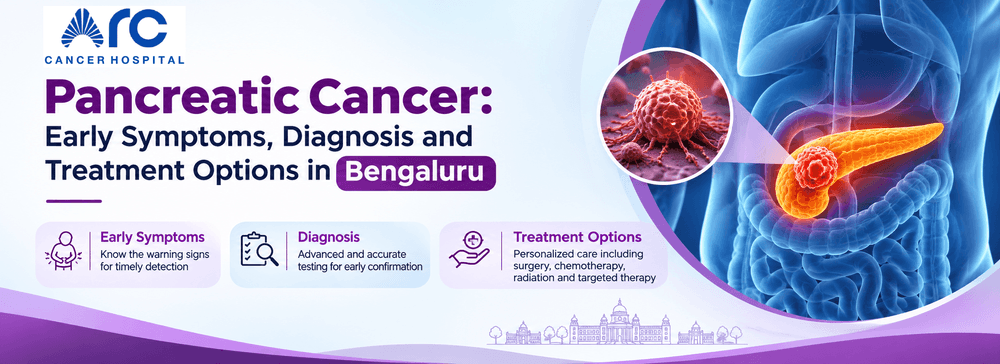
Pancreatic Cancer: Early Symptoms,Diagnosis and Treatment Options in Bengaluru
Pancreatic cancer is one of the cancers that can be difficult to detect in its early stages. Located deep within the abdomen, behind the stomach, the pancreas plays an important role in digestion and blood sugar regulation. Since early-stage pancreatic cancer may not produce obvious symptoms, warning signs can sometimes go unnoticed or be mistaken for common digestive problems.
Recognising persistent symptoms, understanding individual risk factors and seeking timely medical evaluation can help patients receive an appropriate diagnosis and explore suitable treatment options.
For individuals concerned about pancreatic cancer in Bangalore, understanding the diagnostic process is an important first step. At ARC Cancer Hospital, Bengaluru, a multidisciplinary approach to cancer care brings together clinical evaluation, diagnostic investigations and personalised treatment planning.
Early Symptoms of Pancreatic Cancer You Should Not Ignore
Recognising the early symptoms of pancreatic cancer can be challenging because the disease may not produce noticeable signs initially. However, persistent changes in digestion, appetite, weight and overall health should not be overlooked.
Common Signs and Symptoms
1. Jaundice
Yellowing of the skin and whites of the eyes is an important warning sign. It may occur when a tumour in the head of the pancreas obstructs the bile duct, causing bilirubin to accumulate in the bloodstream.
Other symptoms may include dark-coloured urine, pale stools and persistent itching. Jaundice requires prompt medical assessment, even when there is no abdominal pain.
2. Persistent Abdominal or Back Pain
Some individuals experience discomfort in the upper abdomen that extends towards the back. The pain may become more noticeable after meals or when lying down. Unexplained or persistent discomfort should be medically evaluated.
3. Unexplained Weight Loss and Loss of Appetite
Unintentional weight loss, reduced appetite, nausea and feeling full after eating small quantities may occur in individuals with pancreatic cancer.
4. Changes in Digestion and Stool Patterns
Since the pancreas produces enzymes that help digest food, pancreatic dysfunction may cause bloating, greasy or oily stools, foul-smelling bowel movements and changes in digestion.
5. Unexplained Blood Clots
Pancreatic cancer may increase the tendency to develop blood clots. Deep vein thrombosis (DVT) can cause swelling, warmth, redness or pain in one leg. Sudden leg swelling or unexplained breathlessness requires urgent medical attention.
New-Onset Diabetes and Pancreatic Cancer
Newly diagnosed diabetes in adulthood, particularly when accompanied by unexplained weight loss or other concerning symptoms, may warrant further clinical evaluation.
Diabetes is common, and most people diagnosed with it do not have pancreatic cancer. However, pancreatic cancer can sometimes affect insulin production and blood sugar regulation.
Important: These symptoms do not necessarily indicate pancreatic cancer. Persistent or unexplained symptoms should be evaluated by a qualified medical professional.
Pancreatic Cancer Causes and Risk Factors
Pancreatic cancer develops when abnormal cells in the pancreas begin to grow uncontrollably. Although the exact cause is not always identifiable, certain lifestyle, medical and inherited factors are associated with an increased risk.
1. Tobacco Consumption: Smoking is an established risk factor. Avoiding tobacco and seeking support to quit smoking can help reduce the risk.
2. Chronic Pancreatitis: Long-term inflammation of the pancreas can damage pancreatic tissue and is associated with an increased risk of pancreatic cancer.
3. Obesity and Metabolic Factors: Excess body weight and metabolic conditions have been associated with an increased risk. Maintaining a healthy weight, following a balanced diet and staying physically active support overall health.
4. Diabetes: Long-standing diabetes is associated with an increased risk. In some individuals, newly diagnosed diabetes may also be an early manifestation of an underlying pancreatic condition.
5. Family History and Genetic Predisposition: Certain inherited mutations, including BRCA1, BRCA2, PALB2, CDKN2A, ATM and STK11, as well as genes associated with Lynch syndrome, may increase susceptibility.
Individuals with a significant family history of pancreatic cancer may benefit from genetic counselling and specialist assessment.
Having one or more risk factors does not mean that a person will necessarily develop pancreatic cancer.
Pancreatic Cancer Diagnosis: Tests and Investigations
Accurate diagnosis is essential for determining the type, location and extent of pancreatic cancer. The diagnostic process generally involves clinical assessment, imaging investigations, blood tests and, where necessary, tissue sampling.
1. Pancreas-Protocol CT Scan
A contrast-enhanced CT scan using a dedicated pancreatic protocol is an important investigation when pancreatic cancer is suspected.
It helps doctors assess the tumour's size and location, its relationship with surrounding blood vessels and possible involvement of nearby organs. These findings also help determine whether surgical removal may be possible.
2. MRI and MRCP
Magnetic Resonance Imaging (MRI) provides detailed images of the pancreas and surrounding soft tissues.
Magnetic Resonance Cholangiopancreatography (MRCP) is a specialised MRI technique used to visualise the pancreatic and bile ducts. It may be recommended when additional information about pancreatic lesions, cysts or ductal abnormalities is required.
3. Endoscopic Ultrasound (EUS) and Guided Biopsy
Endoscopic Ultrasound (EUS) combines endoscopy with ultrasound imaging to examine the pancreas from within the digestive tract.
A specialised endoscope fitted with an ultrasound probe is passed through the mouth into the stomach or duodenum. Where clinically indicated, EUS-guided Fine-Needle Aspiration (FNA) or Fine-Needle Biopsy (FNB) may be performed to collect tissue samples for examination.
4. CA 19-9 Tumour Marker Test
CA 19-9 is a blood marker that may be elevated in some individuals with pancreatic cancer. Doctors may use it as an additional tool during evaluation and to monitor treatment response in selected patients.
However, CA 19-9 cannot independently diagnose pancreatic cancer. Its levels can also increase in certain non-cancerous conditions, while some patients with pancreatic cancer may have normal levels.
5. PET-CT Scan
A whole-body FDG PET-CT scan may be recommended in selected cases to evaluate suspicious areas and assess possible disease spread.
It can provide additional information for staging and treatment planning. However, it is not necessary for every patient and cannot exclude microscopic cancer spread.
The treating oncology team determines which investigations are appropriate for each patient.
Hereditary Pancreatic Cancer Screening in Bengaluru
Routine pancreatic cancer screening is not recommended for the general population. However, selected individuals with a significant family history or specific inherited genetic conditions may benefit from specialist-led surveillance.
Individuals who may require assessment include:
- People with multiple close relatives affected by pancreatic cancer.
- Individuals with certain inherited genetic mutations.
- People with hereditary conditions such as Peutz-Jeghers syndrome.
- Individuals whose family history meets established high-risk assessment criteria.
What Does High-Risk Surveillance Involve?
Depending on the individual's risk profile, specialists may recommend:
- Detailed family history and risk assessment.
- Genetic counselling and appropriate genetic testing.
- MRI of the pancreas with MRCP.
- Endoscopic Ultrasound (EUS).
- Periodic specialist consultations and follow-up.
The frequency and type of surveillance depend on individual risk and clinical findings. CA 19-9 should not be used as a standalone screening method in asymptomatic individuals.
At ARC Cancer Hospital, individuals concerned about hereditary pancreatic cancer risk can seek specialist consultation to understand their risk and discuss appropriate investigations.
Pancreatic Cancer Stages and Resectability
Once pancreatic cancer is diagnosed, doctors determine its stage to understand how far the disease has progressed and identify suitable treatment options.
- Stage I: Cancer is confined to the pancreas.
- Stage II: Cancer may have grown beyond the pancreas or spread to nearby lymph nodes.
- Stage III: Cancer has extensively involved nearby major blood vessels or regional structures without distant metastasis.
- Stage IV: Cancer has spread to distant organs, such as the liver, lungs or abdominal lining.
Specialists also assess whether the tumour can be surgically removed. This is known as resectability.
Clinical Classification Based on Resectability
1. Resectable: The tumour can potentially be removed through surgery without unacceptable involvement of major blood vessels.
2. Borderline Resectable: The tumour has limited involvement of nearby blood vessels. Chemotherapy may be recommended before surgery to assess treatment response and determine surgical feasibility.
3. Locally Advanced: The cancer involves major surrounding blood vessels or structures, making immediate surgical removal unsuitable. Treatment generally involves systemic therapy, with radiation considered in selected cases.
4. Metastatic: The cancer has spread to distant organs. Treatment focuses on controlling disease progression, managing symptoms and maintaining quality of life.
Understanding Pancreatic Cancer Survival Rates
According to US National Cancer Institute SEER data for people diagnosed between 2015 and 2021, the five-year relative survival rates for pancreatic cancer were approximately:
Extent of disease | Five-year relative survival |
Localised | 44% |
Regional | 17% |
Distant | 3% |
These figures are based on US population data and are not specific to Indian patients or ARC Cancer Hospital.
Individual outcomes depend on the cancer subtype, stage, possibility of complete surgical removal, overall health and response to treatment. Pancreatic neuroendocrine tumours are a distinct group and may have substantially different outcomes from the more common pancreatic ductal adenocarcinoma.
Patients should discuss their individual prognosis with their treating oncologist.
Pancreatic Cancer Treatment Options in Bangalore
Pancreatic cancer treatment depends on the tumour's location, stage, resectability, molecular characteristics and the patient's overall health.
A multidisciplinary team of surgical, medical and radiation oncologists evaluates these factors to determine the most appropriate treatment approach.
1. Whipple Surgery (Pancreaticoduodenectomy)
Whipple surgery is a major procedure commonly performed for selected tumours located in the head of the pancreas.
It involves removing the head of the pancreas, duodenum, gallbladder and part of the bile duct, followed by reconstruction of the digestive tract. Depending on the surgical approach, a portion of the stomach may also be removed.
It is a complex procedure requiring careful patient selection and specialised surgical expertise.
2. Distal Pancreatectomy
Distal pancreatectomy is performed for selected tumours located in the body or tail of the pancreas.
The procedure involves removing the affected portion of the pancreas and may also include removal of the spleen. The surgical approach may be open or minimally invasive, depending on clinical suitability.
3. Chemotherapy
Chemotherapy uses anti-cancer medicines to destroy cancer cells or slow their growth.
It may be recommended before surgery, after surgery or as the primary treatment for locally advanced or metastatic disease.
Common regimens include FOLFIRINOX and gemcitabine-based combinations. The choice depends on the patient's overall health, disease stage and treatment goals.
4. Radiation Therapy
Radiation therapy uses carefully planned high-energy radiation to target cancer cells.
Techniques such as Intensity-Modulated Radiation Therapy (IMRT) and Stereotactic Body Radiation Therapy (SBRT) may be considered in selected cases for local tumour control or symptom relief.
5. Targeted Therapy and Immunotherapy
Molecular and genetic testing can provide additional information about tumour characteristics.
Some patients with specific genetic alterations or biomarkers may be eligible for targeted treatments or immunotherapy.
For example, selected patients with germline BRCA1 or BRCA2 mutations may be considered for specific treatment approaches, including PARP inhibitor maintenance therapy in appropriate clinical circumstances. Patients with biomarkers such as MSI-H or dMMR may be eligible for certain immunotherapy options.
These treatments are not suitable for every patient. Their use depends on molecular findings, disease stage and individual clinical eligibility.
6. Supportive and Palliative Care
Supportive care is an important part of pancreatic cancer management. It may include nutritional assessment, pancreatic enzyme replacement when required, pain management, psychological counselling and rehabilitation.
For patients with advanced disease, palliative care helps manage symptoms, improve comfort and support quality of life.
Pancreatic Cancer Treatment Cost in Bangalore
Understanding the potential cost of pancreatic cancer diagnosis and treatment can help patients and families plan their care.
The overall pancreatic cancer treatment cost in Bangalore varies depending on:
- Disease stage and tumour type.
- Diagnostic investigations and biopsy requirements.
- Surgical complexity and hospitalisation.
- Chemotherapy regimen and number of cycles.
- Radiation therapy techniques and duration.
- Medicines, supportive care and follow-up requirements.
Treatment phase | Factors influencing cost |
Diagnostic evaluation | CT, MRI/MRCP, EUS, biopsy and laboratory investigations |
Genetic and molecular testing | Genetic counselling and appropriate testing |
Pancreatic surgery | Surgical procedure, ICU, hospital stay and post-operative care |
Drug regimen, number of cycles and supportive medicines | |
Radiation therapy | Treatment planning, technology and number of sessions |
Follow-up care | Consultations, imaging and prescribed medicines |
There is no single treatment cost applicable to every patient. An individual estimate should be prepared after reviewing the diagnosis and recommended treatment plan.
At ARC Cancer Hospital, patients and caregivers can consult the hospital's financial counselling team to understand applicable treatment estimates, insurance requirements and payment-related queries.
Treatment costs are subject to clinical assessment and hospital confirmation and may vary depending on individual requirements.
Choosing a Cancer Hospital in Bangalore for Pancreatic Cancer Treatment
Choosing the right cancer hospital is an important decision for patients diagnosed with pancreatic cancer.
Some important factors to consider include:
1. Multidisciplinary Oncology Team: Pancreatic cancer management may involve surgical oncologists, medical oncologists, radiation oncologists, radiologists, pathologists and gastroenterologists.
2. Diagnostic Facilities: Access to appropriate imaging, biopsy and pathology services is important for establishing an accurate diagnosis and planning treatment.
3. Surgical and Treatment Expertise: Patients being considered for pancreatic surgery require careful evaluation of tumour resectability, surgical risks and post-operative care.
4. Supportive Care: Nutrition, pain management, psychological support and rehabilitation are important components of comprehensive cancer care.
5. Financial and Insurance Guidance: Understanding treatment estimates and insurance eligibility can help patients and families make informed decisions.
Pancreatic Cancer Evaluation and Treatment at ARC Cancer Hospital, Bengaluru
At ARC Cancer Hospital, located in Wilson Garden, Bengaluru, the focus is on providing coordinated cancer evaluation and treatment through a multidisciplinary approach.
Patients with suspected or diagnosed pancreatic cancer can seek specialist consultation to understand their diagnosis, explore appropriate investigations and discuss available treatment options.
The treatment approach is guided by the patient's medical condition, disease stage and individual clinical requirements.
If you or a family member is experiencing persistent upper abdominal discomfort, unexplained weight loss, jaundice or other concerning symptoms, seek timely medical evaluation.
An informed diagnosis and an appropriate treatment plan are important steps towards better cancer care.
Contact ARC Cancer Hospital, Bengaluru, to schedule a consultation and discuss your healthcare concerns with the appropriate specialist.
Frequently Asked Questions About Pancreatic Cancer
1. What are the early symptoms of pancreatic cancer?
Common warning signs include jaundice, dark urine, pale stools, unexplained weight loss, loss of appetite and persistent upper abdominal or back pain. These symptoms can also occur due to other conditions and should be evaluated by a doctor.
2. Which test is used to diagnose pancreatic cancer?
Diagnosis generally involves clinical assessment and imaging investigations such as a pancreas-protocol CT scan or MRI/MRCP. EUS-guided tissue sampling may be recommended when a biopsy is required. CA 19-9 is an additional marker but cannot confirm cancer independently.
3. What causes pancreatic cancer?
Risk factors include tobacco consumption, chronic pancreatitis, obesity, diabetes, advancing age and certain inherited genetic mutations. Some people develop pancreatic cancer without identifiable risk factors.
4. Can pancreatic cancer be detected through a blood test?
There is no single blood test that reliably diagnoses pancreatic cancer. CA 19-9 may help in evaluation and monitoring, but diagnosis requires appropriate clinical assessment and imaging, with tissue sampling when indicated.
5. Is pancreatic cancer screening available in Bangalore?
Specialist-led surveillance may be recommended for selected individuals with a significant family history or inherited genetic conditions. MRI/MRCP and EUS are commonly used methods. Routine screening is not recommended for individuals at average risk.
6. What are the treatment options for pancreatic cancer?
Treatment may include Whipple surgery, distal pancreatectomy, chemotherapy, radiation therapy and biomarker-guided targeted treatment or immunotherapy in selected cases. The appropriate approach depends on disease stage and individual clinical findings.
7. What is the survival rate for pancreatic cancer?
Survival varies depending on cancer type, stage, surgical eligibility and response to treatment. US SEER statistics report five-year relative survival rates of approximately 44% for localised, 17% for regional and 3% for distant pancreatic cancer. These figures cannot predict an individual's outcome.
8. How much does pancreatic cancer treatment cost in Bangalore?
Costs vary depending on diagnostic investigations, surgery, chemotherapy, radiation therapy, hospitalisation and supportive care. Patients should obtain an individualised estimate after clinical evaluation.
9. What is Whipple surgery, and when is it recommended?
Whipple surgery, or pancreaticoduodenectomy, is a complex operation used to remove selected tumours located in the head of the pancreas. It is considered when the tumour is suitable for surgical removal and the patient can safely undergo the procedure.
10. Should I consult a medical oncologist or surgical oncologist for pancreatic cancer?
The appropriate specialist depends on the patient's symptoms and investigation results. Individuals with suspected pancreatic cancer may initially be evaluated by a surgical oncologist or gastroenterologist. Once diagnosed, a multidisciplinary team coordinates the required treatment consultations.
Medical Disclaimer: This article is intended for general educational purposes and should not be considered a substitute for professional medical advice, diagnosis or treatment. Screening, diagnostic investigations and treatment decisions should be made in consultation with qualified medical professionals.
Cost Disclaimer: Treatment costs are indicative and subject to hospital confirmation. Actual costs may vary depending on the patient's condition, treatment requirements, hospitalisation and prescribed medicines.
Need Cancer Care Guidance or a Second Opinion?
Consult senior surgical, medical, and radiation oncology specialists at ARC Cancer Hospital, Wilson Garden, Bangalore.